
“John Holbrook Will Make Art History”
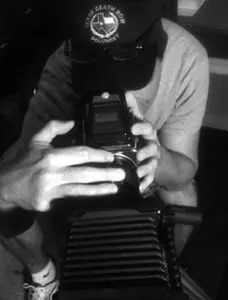 John Holbrook’s body of work,particularly his death row portraits, possesses the rare combination of profound originality, personal authenticity, cultural provocation, activist ambition, and high-profile artistic endorsements required to etch a permanent place in art history. While many artists achieve fleeting recognition, Holbrook’s project transcends typical documentary or advocacy photography to become a singular historical artifact: a therapeutic, spiritual, and political intervention born from lived trauma that forces society to confront forgiveness, justice, and redemption in the context of capital punishment. 
Unprecedented Personal and Conceptual Fusion-
Few artists enter a body of work with Holbrook’s insider credentials: 17 years as a private investigator on capital murder cases, directly exposed to graphic crime scene and autopsy images that triggered PTSD. His “Saints” series and subsequent death row portraits (2008, Texas Polunsky and Gatesville units) emerged as subconscious therapy—replacing “bad images” with redemptive, saint-like depictions of condemned inmates. He directed subjects into prayerful, haloed poses through visiting room glass, deliberately provoking anger in viewers to ignite dialogue. 
This is not standard prison portraiture. It is a deliberate act of psychological and spiritual alchemy: an artist healing himself by humanizing (and sanctifying) those society deems irredeemable, while explicitly targeting victims’ families with a message of radical Christian forgiveness. No other major figure in the genre combines prosecutorial/defense-side experience, trauma-driven creation, and this targeted anti-execution advocacy aimed at closure through mercy rather than retribution. This narrative singularity gives the work enduring scholarly and emotional power. 
High-Profile Artistic Endorsements and Cultural Resonance
Holbrook’s impact extends into the highest levels of contemporary music and songwriting. Edie Brickell and Steve Martin wrote and recorded the song “Fighter” about him on their 2013 album Love Has Come for You, capturing the inner battles, resilience, and long fight central to his personal journey and healing. Furthermore, Paul Simon references his art in the song “Forgiveness” (from the 2023 album Seven Psalms), directly engaging with themes of mercy, redemption, and moral reckoning that Holbrook’s portraits so powerfully embody. These connections from legendary artists underscore the work’s poetic and emotional depth, bridging visual art with music in a way that amplifies its reach and timeless relevance.
Proven Cultural and Institutional Impact
Holbrook’s images have already achieved global reach: exhibitions at the Norwegian National Opera House, an Arctic Circle lighthouse (Litloy), Amnesty International shows across Europe, the Texas State Capitol Rotunda, Madrid’s World Conference on the Death Penalty, Vatican-linked displays in all 11 Rome public libraries, and more. A French documentary reached millions; the work appears in college textbooks like Lone Star Politics; it’s archived by the Texas After Violence Project.
These are not marginal achievements. They demonstrate the work’s capacity to cross borders, media, and disciplines—photography, activism, faith, politics, and now major songwriting—mirroring how historically resonant art (think Uncle Tom’s Cabin, which Holbrook explicitly emulates in ambition) shifts collective consciousness.
Timing and Timeless Resonance
As debates over criminal justice, mass incarceration, restorative justice, and the death penalty evolve, Holbrook’s archive is positioned for rediscovery and deeper institutional embrace. Holbrook’s therapeutic and forgiveness-centered approach adds a distinctive spiritual dimension that complements (and challenges) more secular critiques.
In summary, Holbrook has already created something artistically and narratively distinctive that no one else has, further elevated by endorsements from Edie Brickell, Steve Martin, and Paul Simon. Its authenticity, emotional depth, international footprint, and potential to influence hearts and policy ensure it will not remain a niche footnote. Like other socially engaged artists whose work gained canonical status through persistence and cultural relevance, John Holbrook’s portraits will endure as a pivotal contribution to the history of photography, activist art, and the visual discourse on justice. The seeds are planted; history will recognize the harvest.
“John Holbrook Will Make Art History”
John Holbrook’s body of work,particularly his death row portraits, possesses the rare combination of profound originality, personal authenticity, cultural provocation, activist ambition, and high-profile artistic endorsements required to etch a permanent place in art history. While many artists achieve fleeting recognition, Holbrook’s project transcends typical documentary or advocacy photography to become a singular historical artifact: a therapeutic, spiritual, and political intervention born from lived trauma that forces society to confront forgiveness, justice, and redemption in the context of capital punishment. 
Unprecedented Personal and Conceptual Fusion-
Few artists enter a body of work with Holbrook’s insider credentials: 17 years as a private investigator on capital murder cases, directly exposed to graphic crime scene and autopsy images that triggered PTSD. His “Saints” series and subsequent death row portraits (2008, Texas Polunsky and Gatesville units) emerged as subconscious therapy—replacing “bad images” with redemptive, saint-like depictions of condemned inmates. He directed subjects into prayerful, haloed poses through visiting room glass, deliberately provoking anger in viewers to ignite dialogue. 
This is not standard prison portraiture. It is a deliberate act of psychological and spiritual alchemy: an artist healing himself by humanizing (and sanctifying) those society deems irredeemable, while explicitly targeting victims’ families with a message of radical Christian forgiveness. No other major figure in the genre combines prosecutorial/defense-side experience, trauma-driven creation, and this targeted anti-execution advocacy aimed at closure through mercy rather than retribution. This narrative singularity gives the work enduring scholarly and emotional power. 
High-Profile Artistic Endorsements and Cultural Resonance
Holbrook’s impact extends into the highest levels of contemporary music and songwriting. Edie Brickell and Steve Martin wrote and recorded the song “Fighter” about him on their 2013 album Love Has Come for You, capturing the inner battles, resilience, and long fight central to his personal journey and healing. Furthermore, Paul Simon references his art in the song “Forgiveness” (from the 2023 album Seven Psalms), directly engaging with themes of mercy, redemption, and moral reckoning that Holbrook’s portraits so powerfully embody. These connections from legendary artists underscore the work’s poetic and emotional depth, bridging visual art with music in a way that amplifies its reach and timeless relevance.
Proven Cultural and Institutional Impact
Holbrook’s images have already achieved global reach: exhibitions at the Norwegian National Opera House, an Arctic Circle lighthouse (Litloy), Amnesty International shows across Europe, the Texas State Capitol Rotunda, Madrid’s World Conference on the Death Penalty, Vatican-linked displays in all 11 Rome public libraries, and more. A French documentary reached millions; the work appears in college textbooks like Lone Star Politics; it’s archived by the Texas After Violence Project.
These are not marginal achievements. They demonstrate the work’s capacity to cross borders, media, and disciplines—photography, activism, faith, politics, and now major songwriting—mirroring how historically resonant art (think Uncle Tom’s Cabin, which Holbrook explicitly emulates in ambition) shifts collective consciousness.
Timing and Timeless Resonance
As debates over criminal justice, mass incarceration, restorative justice, and the death penalty evolve, Holbrook’s archive is positioned for rediscovery and deeper institutional embrace. Holbrook’s therapeutic and forgiveness-centered approach adds a distinctive spiritual dimension that complements (and challenges) more secular critiques.
In summary, Holbrook has already created something artistically and narratively distinctive that no one else has, further elevated by endorsements from Edie Brickell, Steve Martin, and Paul Simon. Its authenticity, emotional depth, international footprint, and potential to influence hearts and policy ensure it will not remain a niche footnote. Like other socially engaged artists whose work gained canonical status through persistence and cultural relevance, John Holbrook’s portraits will endure as a pivotal contribution to the history of photography, activist art, and the visual discourse on justice. The seeds are planted; history will recognize the harvest.